


Demo: Animosity | How I recorded, mixed, and mastered
- DR

- Jan 31, 2019
- 3 min read
Song name: Animosity
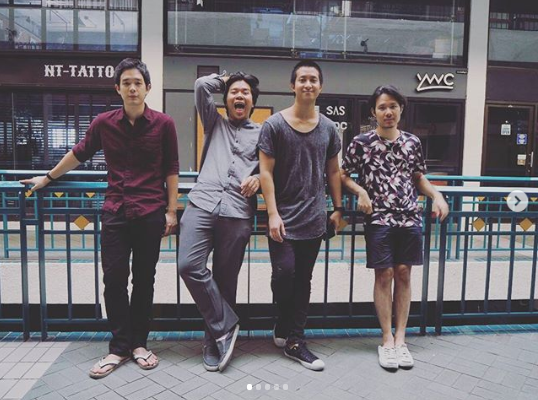
Music by: PROPELLER BAND
Guitars: Daniel | Daniel Rattanamahattana Bass: Tae | Pitcha Sangtakerng Drums: Ben | Noppawat Wattanasuk
Recorded at: Creme Academy Studio, Bangkok
Recorded, Mixed, Mastered by: Daniel Rattanamahattana
Here is the break down of how I recorded, mixed, and mastered this track.
Recording (10 hours)
I spent roughly 10 hours total for tracking all the instruments (5 for drums, 5 for guitars, and less than 1 hour for bass!).
Gears used:
Drum: Ludwig drum set
Bass: Fender Am Standard Jazz Bass, Ampeg PF-350
Guitar: Gibson Les Paul R9, Suhr Badger 30 head, Suhr Riot pedal (distortion) + TC Nova Delay

Microphone list:
Drums: Shure BETA91, BETA52, Shure SM57, Shure KSM44
Bass: Shure SM57
Guitars: Shure SM57 (close), Shure KSM44 (room mic L & R)
Drums (5 hours)
SM57 for all the close mic, except the kick which got the BETA91 inside and BETA52 outside the soundhole. KSM44 for OVH in ORTF configuration behind the drummer.
Guitars (5 hours)
All the guitar parts are tracked the same way, using SM57 close mic pointing at the edge of the Suhr Badger 1x12 cab, and a pair of KSM44's for room mics.
Bass (< 1 hour)
This has got to be the fastest bass recording session ever. We booked a nice rehearsal space for 1 hour from 9PM-10PM, arrived 20min late, but managed to setup the workstation, record 3 takes, and even pack up before 10PM. A simple SM57 close mic setup did the job.
Done!
Mixing (12 hours)
Here comes the fun part - mixing!
This song is a post-rock instrumental track, with a blend between heavy drums and ambient guitar lines. Drums and bass need to be tight and punchy. Rhythm guitars are the wall of distortion, and the leads are harmonies.
Think of Echoes by God Is An Astronaut.

Here is the track again ... in case you are too lazy to scroll back up :)
Drums
I started with mixing the drums and bass, really trying to get them as tight as possible. To simplify the workflow, I group the tracks into busses. This way, I can reduce the number of tracks that I have to deal with, i.e. applying compressors and EQs to the bus instead of the individual tracks.

Here is a summary of the dry mix. I'm a snare reverb addict, hence there's a healthy dose of that in the mix with narrow panning.

For the kick, I scooped out pretty much all the mids between 200Hz and 750Hz to make room for the bass and guitars. Then went with the CLA-3A compressor driving the gain hard to get that tight punchy rock tone, and add a limiter at the end (ratio 100:1, threshold -0.1 dB).
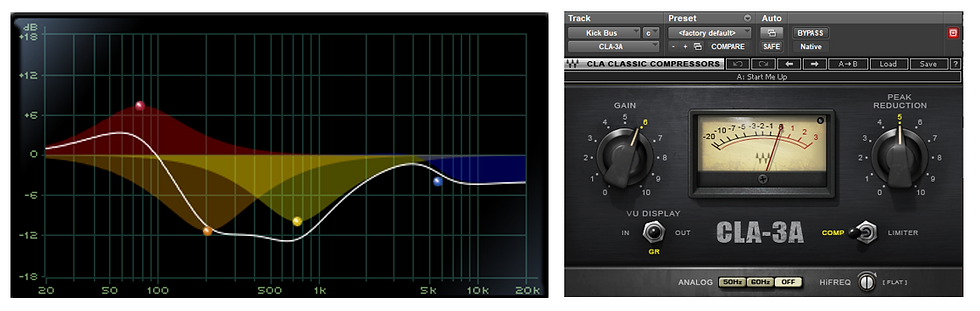
For the main drum bus, I pushed up some midrange at around 320Hz to add body, and then drove the output HARD with the Puigchild 670 compressor. It's unreal how much power and resonance the 670 added to the snare.

Bass
Mixing the bass was tricky on the first attempt. It didn't sound quite right. In fact it sounded like crap.
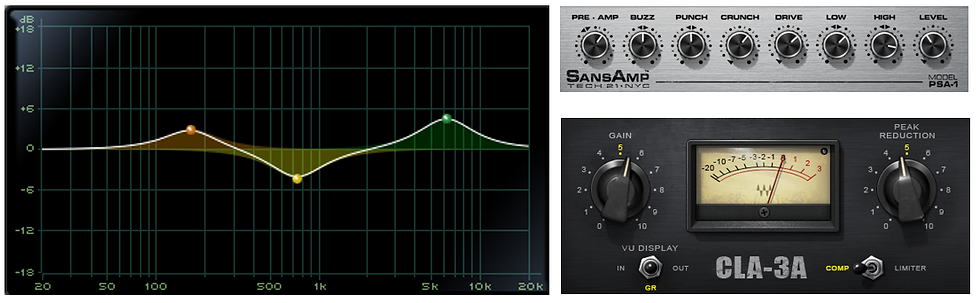
Corrective EQ (and the old faithful CLA-3A) to the rescue!
Boosting the 160Hz and the 6kHz top end helped brought it back to the mix, adding body and definition. The SansAmp overdrive added some grit and attitude, and the CLA-3A was added to the end to keep things tidy.
Guitars
Each guitar line were recorded the same way - SM57 close mic pointing to the edge of the cone, and a pair of KSM44's for room mics. The guitar is my trusty Gibson Les Paul R9. The gain is from the Suhr Riot distortion pedal, with the TC Electronic Nova Delay.
Here is the aux bus diagram. The main melody and the lead lines share the same reverb setting, which is a large hall reverb (4.5 s decay) and mod delays. The rhythm guitars have shorter hall reverb setting at 3.4 s decay.

Now the tracks are clean and ready for wet mix!
All tracks have HPF at roughly 100 Hz to remove any unwanted low end. The idea here is to EQ the 3 guitar linesso they do not sound identical. The main melody had a slight mid hump, while the rhythm and especially lead had a cut in the upper mids to tame the piercing harshness.

Lastly, some volume and panning automation to accentuate the dynamics at the chorus and guitar solo parts.

And on with mastering!
Mastering (1 hour)
For this track the mastering was easy.
I really like using the API 550B to boost up the 2.5kHz in the master channel for rock tracks - really opens up the definition of the snare and guitars. The low end is boosted for that extra oomph.

That's it! You can use these simple techniques for almost any type of rock and modern music.


Comments