


Muse: Assassin | Song Analysis
- DR

- Feb 5, 2019
- 3 min read
Updated: Mar 17, 2019
See if you can resist not headbanging to the riff...
Formed in 1994, Muse is a 3-piece band from the UK whose music is often described as alternative, space rock, progressive rock, and electronica.
The band members are Matthew Bellamy (guitar, vocal, synthesizer, keyboards), Chris Wolstenholme (bass, backing vocal), and Dominic Howard (drums).

The Album
Black Holes and Revelations is their 4th studio album, produced by Rich Costey, who also produced their previous album Absolution. Costey shared during an interview about the direction of the recording goal.
“On Absolution, for example, the guitars really sound big, but you don't hear as much of Matt as a true player. When Muse plays live, you can really hear his personality as a player. I wanted to make sure we preserved that - I wanted to make a record where you could hear his fingers on the strings, and you could hear his pick hitting the strings. I wanted a little more clarity on the album than Absolution had on it, perhaps.”
— Rich Costey, Producer
The Song
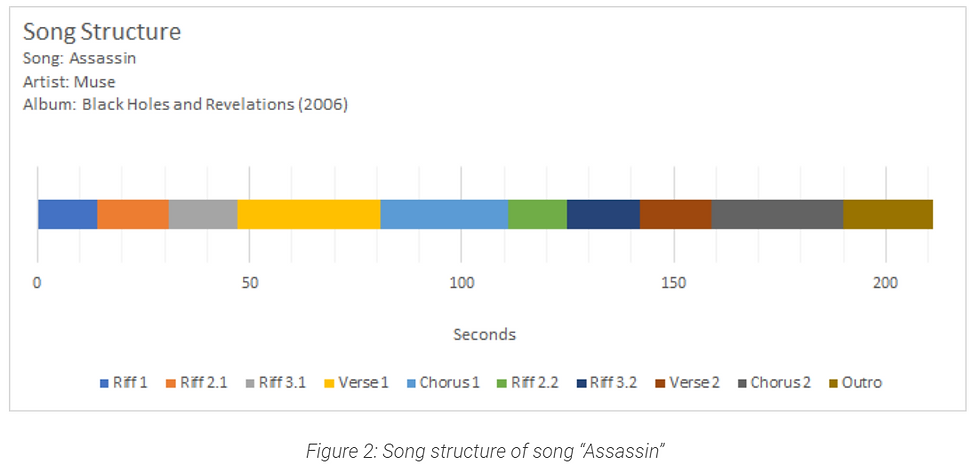
Assassin is the 7th track on the album, written by Bellamy. The song tempo is fast at 125 bpm (roughly the same tempo as Stockholm Syndrome). The song structure, arrangement, and the use of instruments and effects are relatively straightforward and minimalistic compared to some of Muse’s other tracks in the album (see details in Song Structure section below).
This is neither one of Muse’s most effects-heavy nor structurally complex songs, but I want this to be one of my “reference tracks” for my future mixing rock work. I admire the overall power of the song generated from just 3 instruments (guitars, bass, drum) playing such a simple riff.
Producer, Audio Engineers & Facilities for BHAR Album
Recording period: August - December, 2005 Record labels: Warner Bros. Genre: Progressive Rock, Alternative Rock
Production Team:
Producer: Rich Costey Recording Engineer: Tommaso Colliva, Claudius Mittendorfer Mixing Engineer: Rich Costey Mastering Engineer: Vlado Meller, Howie Weinberg
Studios & Facilities:
Recording stage: Studio Miraval (France), Avatar Studios (USA), Electric Lady Studios (USA), Officine Meccaniche (Italy), The Town House (UK)
Mixing stage: All tracks mixed at The Town House (UK) for every song except 'Hoodoo' mixed at Avatar Studios and 'Starlight' mixed at Sony Music Studios, New York.
Mastering stage: Sony Music Studios (USA), Masterdisk (USA)
Song Structure & Effects Analysis
Stereo Image Diagram

Song Structure
Guitars

Assassin heavily showcases Matt’s guitar parts. Line 1 to 3 are straight up mid-hi gain distortion electric guitars — typical of Muse. The rhythm guitar tone is very tight and mid-focused, panning hard left and right via overdubbing to increase thickness.
Line 4 is Matt’s signature Kaoss pad feedback noise, adding texture and space effects. Minimal reverb/delay effects are used in the guitar tracks to put them into the mix, and not as a standout effect. During vocal parts, the rhythm guitars volume are slightly decreased to give room to the vocal tracks.
Vocals & Backup
The vocal is not the focus of this song. It is arranged more to complement the aggressive drop-D guitar riffs.
The main vocal is panned to the center, with equal volume to the other instruments in the mix. The backup vocal panning technique alternates between -100 left (aka hard left) and +50 right during verse parts, and between -20 left and 0 during chorus parts. The backup vocals have volume swell effect on the last words of the sentences, imitating a synthesizer.

Bass
Right from the opening duo riff, the bassline strictly follows the guitar riff for the majority of the song. Chris did not use any of his signature effects such as fuzz, distortion or octave (e.g. bass intro in Hysteria).
There may be slight use of a compressor to keep the bassline consistent, as there is no audible variation in the note volumes at any point. EQ character is set to emphasize low & low-mid, focusing on the bass body and rumble rather than notes separation and definition.
The most sensitive frequency range to bass muddiness is 80-100 Hz. Bass panning remains in the center for the whole song.
Drums
The drum tracks stereo image are focused in the center throughout the song. The kick, snare, and hi-hat are pan center, while ride cymbal is pan -50 left and crash cymbal is at +50 right (perhaps because Dom is left-handed).
There are some percussion effects as heard at 1:17 coming from -100 left (pan hard left). Snare tone is thick and punchy, and tom rolls are deep and rumbling (listen to 0:29).


Comments